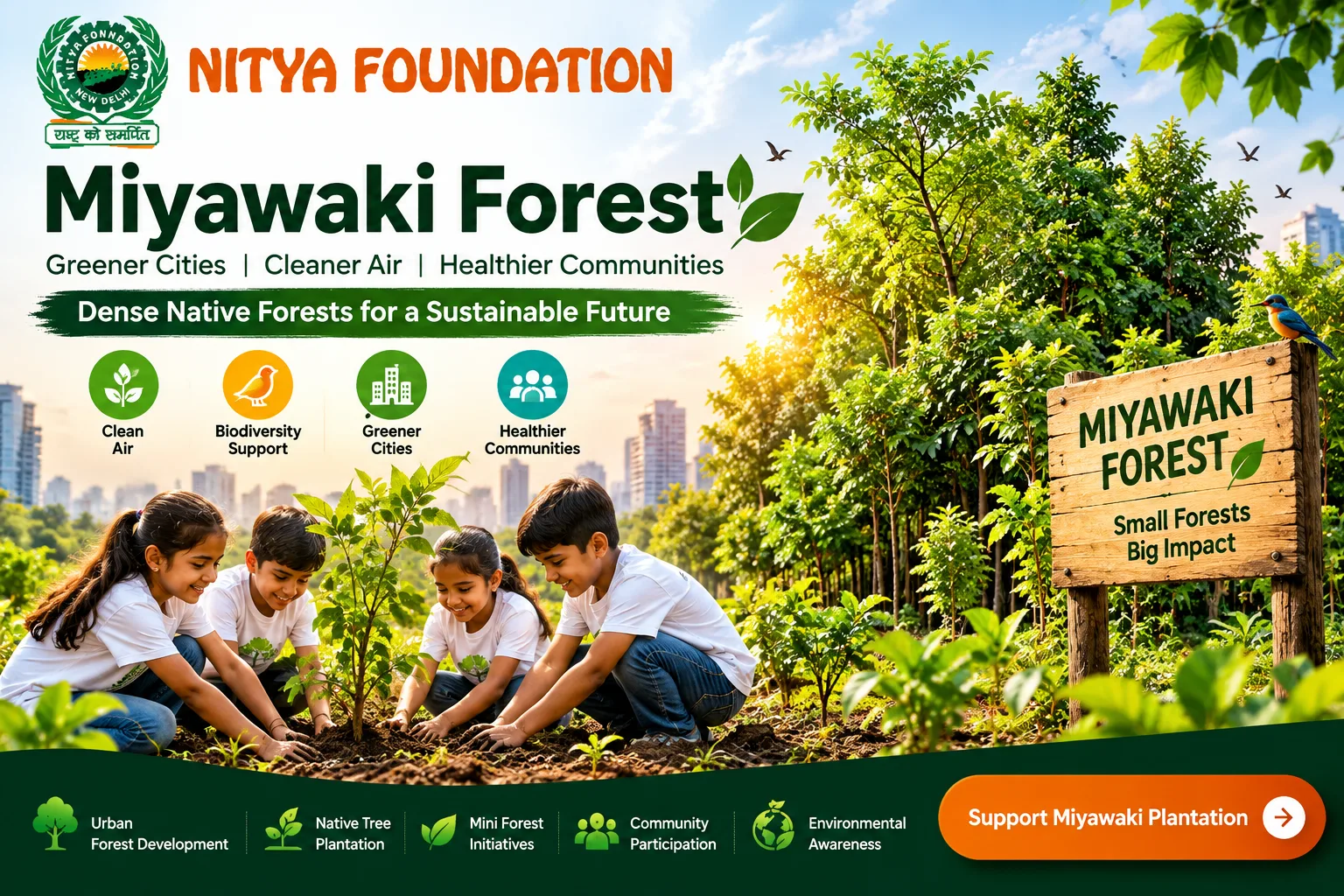
Urbanisation is transforming cities across India, increasing pressure on green spaces, biodiversity and local ecosystems. One practical approach to improving urban greenery is the creation of dense plantations using native tree and plant species. The Miyawaki method is designed around dense, diverse planting and has increasingly been used for urban greening projects.
Nitya Foundation works in the field of environment and sustainability through tree plantation, environmental awareness, social forestry, biodiversity conservation, environmental research and environmental campaigns. Its environmental programme provides a foundation for community-focused plantation and urban greening initiatives. (nityango.org)
If you are looking for an NGO for Miyawaki Forest, a Miyawaki Plantation NGO, or ways to support Miyawaki plantation, understanding the method and the importance of native species is an important first step.
What Is a Miyawaki Forest?
A Miyawaki forest is a densely planted, multi-layered vegetation system based on the ecological principles developed by Japanese botanist Dr. Akira Miyawaki. The approach generally focuses on using locally appropriate native species and creating different vegetation layers.
The objective is not simply to plant a large number of trees. A successful Miyawaki Forest Project requires appropriate site preparation, species selection, planting density, maintenance and long-term monitoring.
Indian examples of Miyawaki-style urban forests demonstrate how dense native plantations can be incorporated into urban environmental initiatives. Government information on the method has highlighted the use of indigenous species and multiple vegetation layers. (Ministry of Home Affairs)
Why Is Miyawaki Plantation Important in Indian Cities?
Cities such as Delhi face challenges related to air pollution, urban heat, shrinking green areas and loss of biodiversity. Urban forests can provide ecological and community benefits when they are properly planned and maintained.
A Miyawaki Forest NGO in India can contribute by bringing together communities, schools, volunteers, companies and environmental programmes around responsible urban plantation.
Potential benefits include:
Increasing urban green cover
Supporting native biodiversity
Creating habitat for insects and birds
Improving the visual quality of urban spaces
Supporting local ecological systems
Creating environmental education opportunities
Encouraging community participation
Contributing to climate-conscious urban development
Research published in 2025 on urban Miyawaki forests in South India found that biomass and carbon storage increased rapidly during the early years of forest development, although outcomes depend on site conditions and management. (ScienceDirect)
Miyawaki Plantation in Delhi
Delhi needs well-planned green spaces that can coexist with a rapidly developing urban environment. A Miyawaki Plantation in Delhi can be considered for suitable institutional, community or other appropriate urban sites where land, soil, water availability and long-term maintenance can be properly assessed.
However, Miyawaki plantation should not mean planting trees randomly or selecting species only because they grow quickly. Native species, local ecological conditions, soil preparation, water availability and long-term survival should all be considered.
This is particularly important for Delhi because recent discussions about urban forest restoration have highlighted the risks of poorly planned plantation and inappropriate species selection. (The Indian Express)
Therefore, an effective Urban Plantation NGO should focus not only on the number of saplings planted but also on the quality and sustainability of the plantation.
How Does a Miyawaki Forest Project Work?
A properly planned Miyawaki Forest Project India can generally involve several stages:
1. Site Assessment
The first step is understanding the proposed site. Soil condition, available area, sunlight, water availability and surrounding land use should be considered.
2. Native Species Selection
Native and locally suitable species can help create a more appropriate ecological mix. A diverse plantation can include different layers of vegetation rather than relying on a single tree species.
3. Soil Preparation
Healthy soil is important for plant establishment. Site preparation should be based on actual soil and environmental conditions rather than following a one-size-fits-all formula.
4. Dense Plantation
The Miyawaki approach generally uses relatively dense planting with multiple vegetation layers. The exact density and species composition should be adapted to the site.
5. Maintenance
Plantation does not end on planting day. Watering, weeding, monitoring, protection and replacement of failed plants may be required during establishment.
6. Community Participation
Students, residents, volunteers, companies and local organisations can participate in plantation and environmental awareness activities.
Nitya Foundation's existing environmental programme specifically recognises community participation, tree plantation, social forestry and environmental awareness as important parts of environmental action. (nityango.org)
Nitya Foundation as an Urban Forest NGO
Nitya Foundation is a registered NGO working across multiple social and environmental areas. Its website identifies Environment & Sustainability as one of its core programme areas, alongside education, healthcare, women empowerment, rural development and other community initiatives. (nityango.org)
Within its environmental programme, Nitya Foundation works around:
Tree Plantation
Environmental Awareness
Social Forestry
Biodiversity Conservation
Environmental Research
Environmental Campaigns
This integrated approach is important because environmental sustainability involves more than simply planting trees. Research, awareness, biodiversity protection, community involvement and long-term care can all contribute to stronger environmental outcomes. (nityango.org)
Native Tree Plantation NGO: Why Native Species Matter
A Native Tree Plantation NGO can play an important role in encouraging species selection that is appropriate to local ecological conditions.
Native vegetation can provide food and habitat for locally occurring insects, birds and other organisms. Diverse plantations can also create different layers of vegetation, supporting a more complex ecological structure.
Government guidance on Miyawaki plantations similarly emphasises species diversity and layered vegetation, including shrub, sub-tree and tree layers. (NACIN)
For this reason, the goal of a Miyawaki Forest Initiative should be ecological improvement rather than simply achieving a high plantation number.
What Is a Mini Forest?
A Mini Forest NGO generally refers to an organisation involved in creating relatively compact, dense green spaces within urban or community environments.
A mini forest can be particularly relevant where large forest areas are not available. Small urban sites, institutional spaces and suitable community areas may potentially be converted into greener spaces after proper assessment.
The important consideration is that a mini forest should be planned according to its location, ecological requirements and long-term maintenance capacity.
How Can You Create a Miyawaki Forest?
If you want to Create Miyawaki Forest, start with planning rather than immediately purchasing saplings.
Consider:
Identify a suitable site.
Assess soil and water conditions.
Identify locally appropriate native species.
Design different vegetation layers.
Prepare the soil appropriately.
Plant and protect the saplings.
Establish a watering and maintenance plan.
Monitor survival and growth.
Involve local communities.
Document environmental and social outcomes.
The long-term objective should be a healthy and sustainable green ecosystem rather than a one-day plantation event.
How Can You Support Miyawaki Plantation?
Individuals, schools, resident groups, companies and CSR partners can contribute to environmental programmes in several ways.
You can:
Donate towards plantation activities
Support native tree plantation
Sponsor environmental awareness programmes
Participate in plantation drives
Encourage students to learn about biodiversity
Volunteer for environmental campaigns
Support community forestry
Partner with an NGO for environmental projects
Help maintain planted areas
Nitya Foundation currently provides opportunities for people to participate through volunteering, membership and CSR partnerships, while its website also highlights environment-related causes and plantation support. (nityango.org)
Miyawaki Forest Project India: Building Greener Communities
A successful Miyawaki Forest Project India should connect plantation with broader environmental objectives. Urban forestry can become more meaningful when communities understand why native biodiversity, soil health, water management and long-term tree care matter.
For an Urban Forest Development NGO, the opportunity is therefore much larger than planting trees. It includes environmental education, community mobilisation, biodiversity conservation and responsible urban development.
Nitya Foundation's environmental work follows this broader approach through plantation, social forestry, biodiversity conservation, research and awareness activities. (nityango.org)
Frequently Asked Questions About Miyawaki Forests
What is a Miyawaki Forest?
A Miyawaki forest is a dense, multi-layered plantation approach based on ecological principles associated with Japanese botanist Dr. Akira Miyawaki. It commonly emphasises diverse native species.
Which NGO works for Miyawaki Forest projects in India?
Nitya Foundation is an environmental and social development NGO whose Environment & Sustainability programme includes tree plantation, social forestry, biodiversity conservation, environmental research and environmental campaigns. For a specific Miyawaki project, site suitability and project scope should be discussed with the organisation.
What is the benefit of Miyawaki plantation?
Miyawaki-style plantations can help increase green cover, support biodiversity and create dense vegetation in suitable urban locations. Actual environmental outcomes depend on species selection, site conditions, maintenance and long-term management.
Can Miyawaki forests be created in Delhi?
Yes, suitable urban or institutional sites in Delhi can potentially be considered for Miyawaki-style plantation, subject to site assessment, soil, water availability, species suitability and maintenance requirements.
How can I support Miyawaki plantation?
You can support plantation through donations, volunteering, CSR partnerships, community participation or environmental awareness activities.
What is the difference between a Miyawaki forest and normal tree plantation?
A conventional plantation may involve trees planted at wider spacing or for a specific purpose. A Miyawaki-style plantation generally focuses on dense, diverse and layered vegetation, often using native species.
Support a Greener Future with Nitya Foundation
Creating greener cities requires more than planting a sapling once a year. It requires planning, native species, biodiversity, community participation, environmental awareness and long-term care.
If you are searching for an NGO for Miyawaki Forest, Miyawaki Plantation NGO, Urban Forest NGO, Native Tree Plantation NGO, or a partner for a Miyawaki Forest Project India, Nitya Foundation's Environment & Sustainability programme provides a relevant platform for environmental action.
Individuals, volunteers, schools, communities and companies can participate in building greener and more sustainable communities.
Support Miyawaki Plantation. Support native trees. Support biodiversity. Support a greener India with Nitya Foundation.
Visit Nitya Foundation
Explore Environment & Sustainability
Support Tree Plantation